Funding & finance
Why engineers need to understand clean-energy tax incentives
Funding and tax incentives are increasingly important to how energy projects are designed, evaluated and delivered.
Originally published on LinkedIn. This article reflects the information and perspective at the time of the original post.
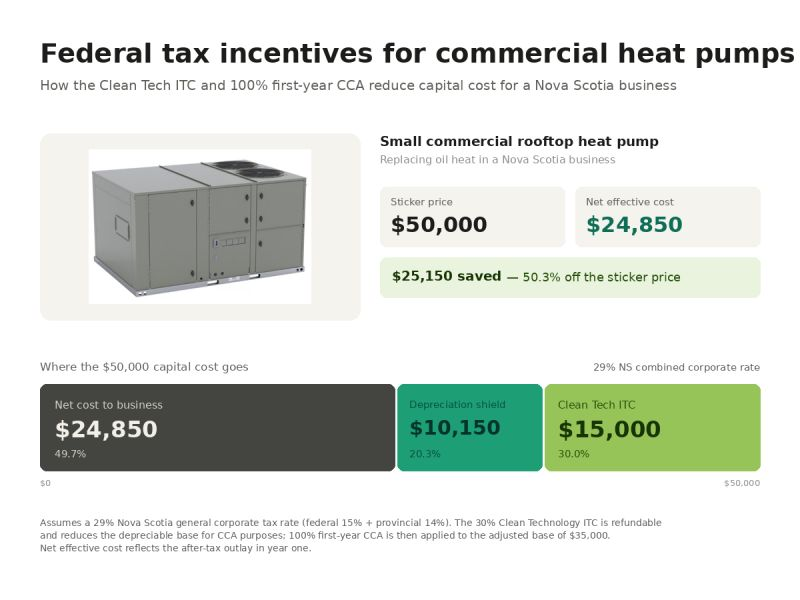
The federal government is now driving the energy transition through the tax code. And most engineers aren’t paying enough attention to it. In my experience, engineers want to design systems and solve problems, not think about tax structures. But that’s becoming a gap. With recent updates through Bill C-15, expanded accelerated depreciation, and new Investment Tax Credits, project economics are increasingly shaped by how well these incentives are understood and applied.
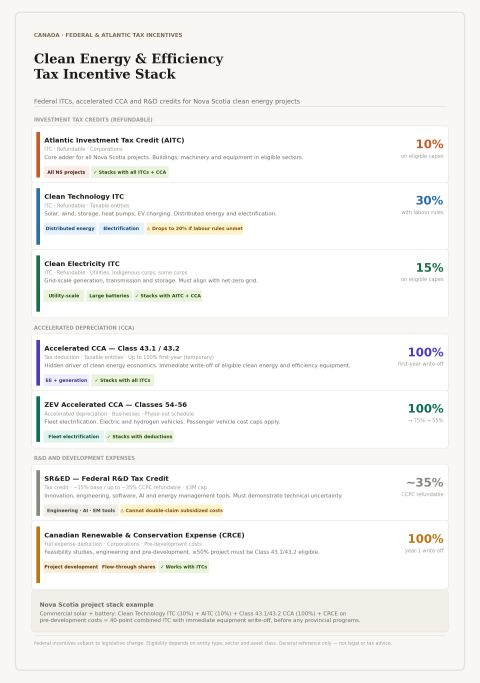
Engineering consultants across Atlantic Canada who understand this will have a major advantage. Too often, projects are still being designed without fully leveraging the available incentives. The chart above shows a simplified view of the stackable federal tax incentives available for clean energy and efficiency projects.
When structured properly, these can fundamentally change project economics: → Improve IRR → Unlock marginal projects → Enable deeper retrofits → Scale across portfolios
These incentives could enable $ billions in investment across Atlantic Canada in heat pumps, electrification, solar, storage, EVs, and industrial efficiency over the coming years.