Energy management
Small businesses need more than efficiency incentives
Rising program costs point to a need for technical expertise, project coordination and support that helps businesses act.
Originally published on LinkedIn. This article reflects the information and perspective at the time of the original post.
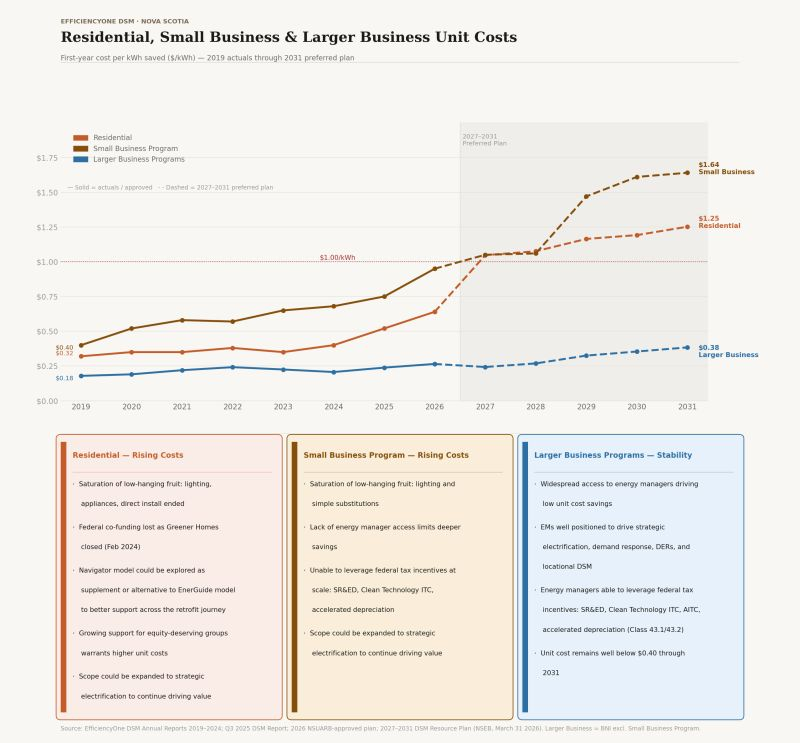
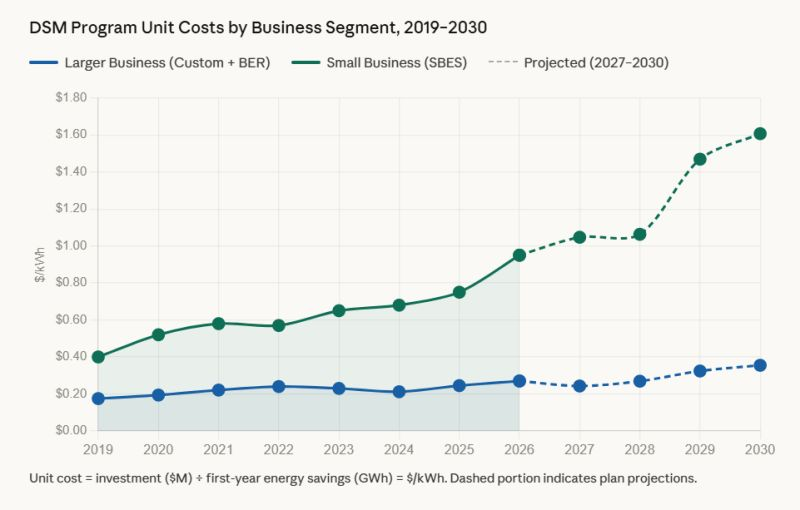
Energy efficiency for small businesses in Nova Scotia is getting more expensive. And that is likely a preview of what is coming for the rest of Canada. Nova Scotia has long been a leader in energy efficiency programming, which means we often see these shifts early. This chart, based on public regulatory filings, shows DSM unit costs for small businesses rising from about $0.40/kWh in 2019 to a projected ~$1.60/kWh by 2030.
Unit costs here mean the program investment required to achieve one kWh of electricity savings. At first glance, that might look like a problem. I see it more as a signal. Nova Scotia has already captured many of the easier opportunities in the small business sector: lighting, basic controls, and other standardized measures.
What remains are more complex projects that require time, coordination, and technical support that many small businesses simply do not have the capacity to manage on their own. So costs rise. The answer is not just bigger incentives or more free installations. That may help at the margin, but it does not solve the core issue.
The real bottleneck is capacity. To unlock the next wave of savings in the small business sector, we need to evolve the support that businesses receive:
- Trusted, on-the-ground technical support to identify, scope, and implement projects
- Project management and coordination support to reduce friction and time investment
- Access to financing and federal incentives, which can often cover 40–50% of capital costs
- Better tools that use available data to generate practical insights
- Clearer pathways to bundle measures and scale action across portfolios
There is also a broader opportunity emerging. Strategic electrification creates a new pathway for small businesses to participate in DSM. For many, the next step is not another lighting upgrade. It is replacing an inefficient end-of-life oil heating system with a high-efficiency heat pump that lowers costs, reduces exposure to volatile fuel markets, and cuts emissions. A new DSM paradigm is emerging in Canada. That creates a real opportunity, but only if we evolve our approach.