Electrification
Transitioning Nova Scotia: Strategies to Phase Out Heating Oil for a Sustainable Future
Lessons from Halifax’s corporate building roadmap on prioritizing heating conversions, coordinating retrofits and planning equipment replacements.

Originally published on LinkedIn. This article reflects the information and perspective at the time of the original post.
This article explores strategies for phasing out heating oil in Nova Scotia and lessons from Halifax Regional Municipality’s experience. David previously managed Energy Management Services at EfficiencyOne and now leads PB Energy; the HRM work described below relates to his earlier energy management experience.
Nova Scotia Climate Goals
The Environmental Goals and Climate Change Reduction Act (EGCCRA),[1] passed in the NS legislature in 2021, calls for the NS economy to be net-zero by 2050. The 2022 NS Climate Change Plan for Clean Growth,[2] the Province’s plan to achieve EGCCRA goals, calls for a ban of oil heating in new buildings by 2025. Implied in the plan is the necessity of completely phasing out oil heating from the existing building stock by 2050.
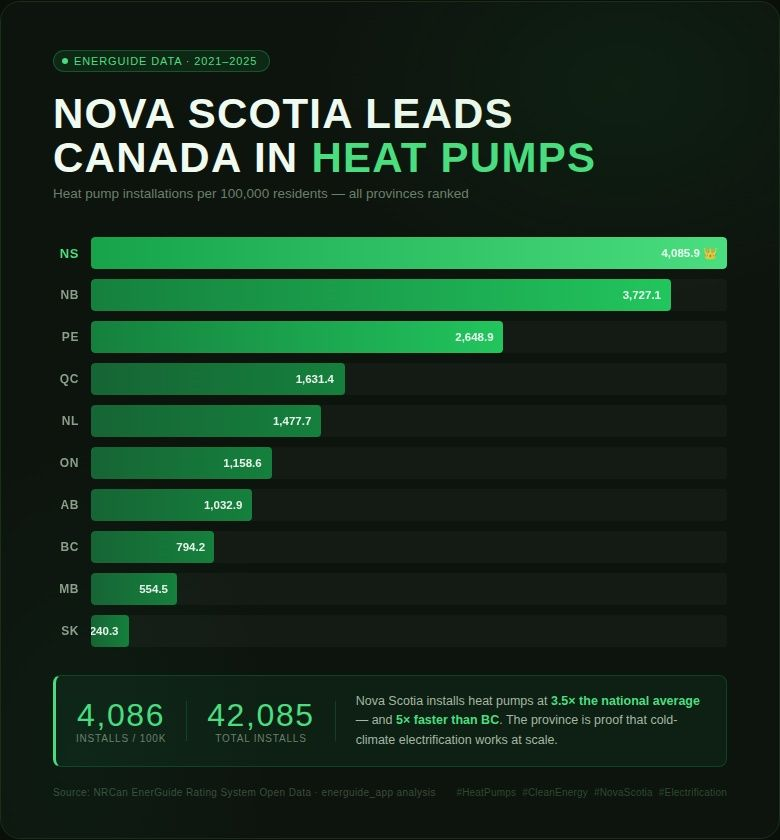
The phase-out of heating oil in Nova Scotia has been underway since the creation of Heritage Gas (now Eastward Energy) in 2003. It is now being primarily driven by the adoption of heat pumps, which have lower operating costs and emissions than both oil and natural gas alternatives.
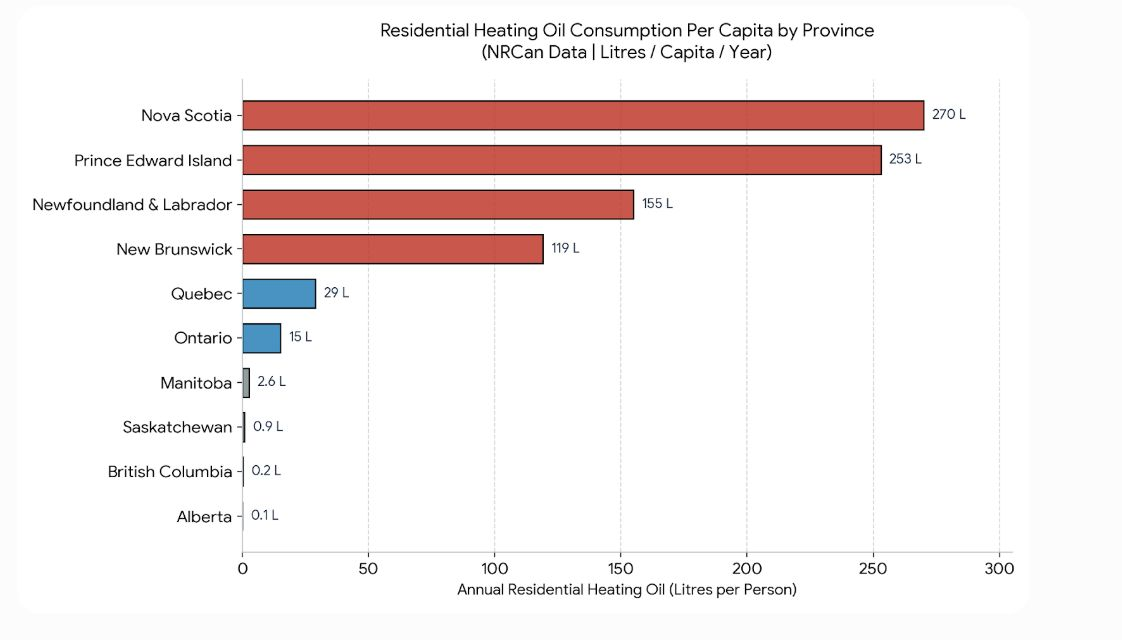
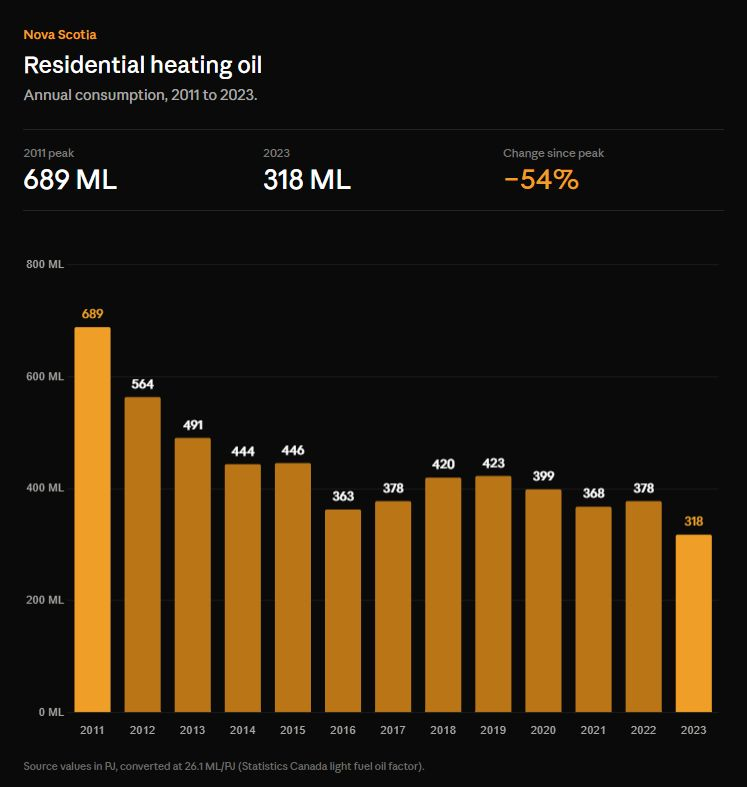
This chart shows a 45% reduction of heating oil usage in the commercial, institutional and residential sectors of Atlantic Canada since 2000[3]. Though this is good progress, the region is responsible for 50% of Canada’s current domestic heating oil consumption in these sectors, a lot for a region with less than 7% Canada’s population.
The Economic Opportunity
The economics of continuing the phase-out of heating oil in Nova Scotia is compelling for several reasons.
- We are not a producer of oil. We import all the oil we consume, hurting our trade balance.
- It is cheaper to produce heat from heat pumps than oil systems. By converting to heat pumps we can increase productivity of businesses and lower cost for residents.
- Nova Scotia is positioned to claim a disproportionate share of generous federal commercial and residential heat pumps incentives.
- Adoption of best-in-class heat pumps and hybrid heat pump systems by Nova Scotians can push electricity rates lower. A recent study commissioned by Nova Scotia Power claims a mini-split in an oil-heated building can save the general rate-base $733/ton in addition to the cost savings to the user [4] This report suggests that the rate base should incentivize heat pumps upgrades.
- Nova Scotia has a leading energy efficiency industry that can help strategically deploy heat pumps at scale while creating local employment opportunities.
Many Provinces with cheap natural gas face difficult economic decisions regarding the adoption of heat pumps. In Nova Scotia, heat pumps as primary heat sources are the obvious solution.
The Halifax Regional Municipality Example
We can learn a lot from HRM which is phasing out oil on an accelerated timeline. HRM has cut its annual consumption by 64% from 3.5 million liters in 2014 to 1.3 million liters in 2020. This was accomplished through energy efficiency measures, natural gas and heat pump conversions, and replacing/retiring aging buildings. With the 2021 HalifACT Climate Plan[5], HRM committed to reducing its corporate emissions to net-zero by 2030.
In my previous energy management work with HRM, I led the development of a Net-Zero Corporate Buildings Roadmap to identify the optimal pathway to achieve the 2030 target. All pathways necessitated eliminating oil usage in the 75 remaining oil consuming buildings. This required an average of 7.5 conversions and 130,000 incremental liters of oil savings each year over 10 years.
To plan the oil conversions for each year, the HRM project team developed an oil conversion prioritization matrix considering such factors as:
- Equipment Age- Proactively replacing end-of-life equipment is by far the most economical approach. It needs to be replaced anyway and the incremental cost of heat pumps, especially with available incentives, pays for itself in short order.
- Annual Oil Consumption-A small number of buildings use a disproportionately large share of the overall heating oil. Focusing on these allows us to make the biggest impact and get ahead of the target.
- Access to Natural Gas-Heat pumps w/ natural gas backup is usually an easy-to-design and optimal solution.
- Distribution type (Hydronic/Forced Air) and Supply Temp- Forced air systems and low-temp hydronic loops are less costly to convert. Heat pumps produce a lower temperature heat than many boilers so high-temp systems can necessitate expensive distribution system upgrades.
- Mechanical Ventilation-Buildings without mechanical ventilation can be made healthier and more comfortable with an HVAC upgrade. This was especially important during the Pandemic.
- Air Conditioning – Installing heat pumps is an opportunity to add air conditioning and improve comfort in spaces that lack it.
These factors and others were weighted and used to determine the order of conversions. Undertaking deep energy retrofits at the time of conversion proved to be a successful approach. Building envelope upgrades reduce the capacity required of the new heating systems. Doing all the work at once minimized disruption to building occupants.
What can we learn from HRM’s approach?
Here are some recommendations from the HRM experience that can help us optimally phase out heating oil and achieve our 2050 goals.
End-of-life Replacements: Most buildings in Nova Scotia will require an end-of-life heating system replacement between now and 2050. A plan should be in place to convert to heat pumps at this time along with building shell improvements that can reduce capacity requirements. Waiting for systems to fail often requires a rushed like-for-like replacement and is a wasted opportunity.
Pace of Conversions: Nova Scotia requires an average of 16 million liters of heating oil savings per year to be on track to meet the 2050 target. The last 20% will be the most difficult so we should seek to achieve >20 million liters of savings per year over the next decade. To put this in perspective, a 1.5 ton residential mini-split heat pump can save 1200 liters of oil per year. A million liters of oil can be saved with 1250 tons of heat pump capacity.
Maximize Incentives: Businesses and residents should take advantage of the myriad incentives that are available for heat pumps conversions.
Small Business
- Up to 80% Rebate through Efficiency Nova Scotia Small Business Energy Solutions Program
- 30% Refundable Federal Clean Technology Investment Tax Credit
- Accelerated Depreciation (75% 1st year Capital Cost Allowance CCA)
Large Business
- 30% Refundable Federal Clean Technology Investment Tax Credit
- Accelerated Depreciation (75% 1st year Capital Cost Allowance CCA)
Residential
- $15,000 Federal Oil to Heat Pump Affordability Program
- Canada Greener Homes Loan
- Home-warming
- Efficiency NS Home Energy Assessment
Consideration should be given to rate-payer funded heat pump incentives based on the findings of the E3 Electrification Report cited above.
Beneficial Electrification: To minimize potential negative impacts on ratepayers, preference should be given to best-in-class cold climate heat pumps and hybrid heat pumps systems. Nova Scotia Power should plan for capacity requirements of an accelerated electrification schedule.
Energy Manager Role: Nova Scotia has a network of Energy Managers working with the largest commercial/institutional/industrial customers. Energy Manager clients represent >30% of commercial electricity usage in NS. These Energy Managers work with thousands of buildings across Nova Scotia. In any given year there are hundreds of these buildings that require end-of-life heating system replacements.
Energy Managers can work with clients to prioritize the conversions, integrate wider energy retrofits, and ensure they are done in a way with minimal impact on ratepayers.
[1] environmental goals and climate change reduction.pdf (nslegislature.ca)
[2] ns-climate-change-plan.pdf (novascotia.ca)
[3] Comprehensive Energy Use Database | Natural Resources Canada (nrcan.gc.ca)
[4] E3_NS-Power_Electrification-Report.pdf (ethree.com)
[5] HalifACT
Reference links and the original chart are available in the LinkedIn article below. Program names, incentive amounts and policy targets above reflect the July 2024 article.