District energy
Nova Scotia’s district energy modernization opportunity
Existing networks serving major institutions offer opportunities to consider electrification and large-scale thermal storage.
Originally published on LinkedIn. This article reflects the information and perspective at the time of the original post.
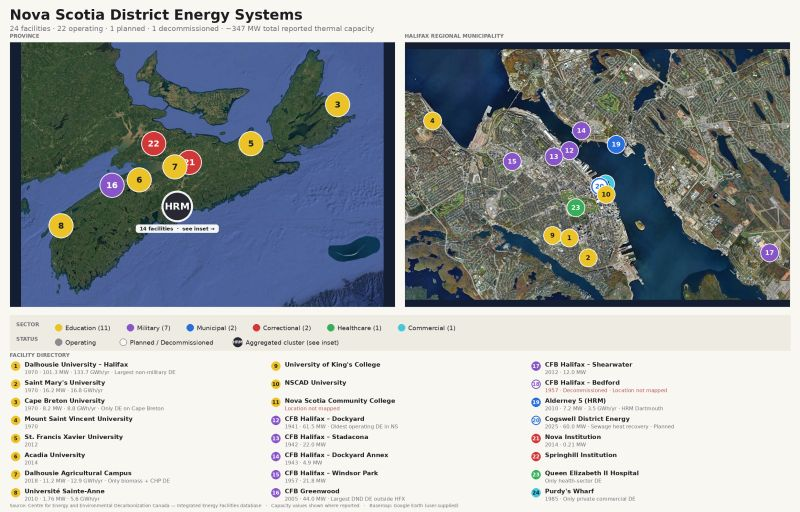
District energy plays an important role in Nova Scotia’s energy system. A district energy system is a shared heating and/or cooling system that serves multiple buildings through a network of pipes. Simon Fraser University’s Canadian Energy and Emissions Data Centre database lists 22 operating district energy systems, 1 planned system, and roughly 347 MW of reported thermal capacity in the province.
These systems serve many of Nova Scotia’s largest anchor loads, including universities, military bases, hospitals, and federal research campuses. Some may be strong candidates for electrification and large-scale thermal storage.
One of the province’s largest district energy systems, at Department of National Defence/Ministère de la défense nationale CFB Halifax, is now set for a major upgrade. As part of the $1.2 billion investment Prime Minister Mark Carney announced for the base in March, an advance procurement notice valued at roughly $507 million is currently out for a design-build team.
The existing combined heat and power system serving the Dockyard and Stadacona sites is slated for demolition, with a new heating solution to take its place.
Hopefully, this is the start of renewed growth and modernization for district energy in Nova Scotia.
Note: Two more not included in CEEDCs: the Bedford Institute of Oceanography and Dartmouth General.